Wednesday, March 4, 2026

Welcome, my chuckaboos! If you weren’t here last week, back in the Steam and Victorian Eras, “Chuckaboo” was slang for dear friend. Cee’s Fun Foto Challenge (CFFC) and the prompt is Gizmos and Gadgets. Dan Antion, the host, posted a lot of modern-day tools. The tools I’m featuring go back a ways. I’m sorry that some of the photos are so small. I suppose that’s because they are from such old sources.
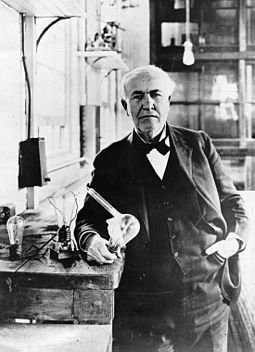
Speaking of slang, we’re visiting the timeframe of 1847 — 1931 to check out the tools of someone you might not know was considered (by modern slang) a big tool. Yes, all of the tools in this post were created by a tool… allegedly. And I don’t mean AI.
You might say he was the Tool of Tools.
Thomas Alva Edison is widely considered the most prolific inventor of useful, commercialized tools, holding 1,093 U.S. patents. However, getting along with him was reportedly quite difficult. He was described as cranky to say the least. He was known for having few close friends because he… well, he wasn’t exactly charming. Associates characterized him as a gruff, egomaniacal, and intense man who struggled socially. His employees said he was a demanding, fickle boss, often neglecting his family to focus solely on his work.
Today, his views about women and minorities would be considered chauvinistic, racist, and prejudiced. Edison believed women were “behind men in direct thought due to historical, not biological, factors.” In his later years, expressed views on the intellectual inferiority of Black people, and he made anti-Semitic comments — to the press, and he was accused of discriminating against Jewish employees.
Edison’s inventions established major industries, including the electric light bulb, phonograph, and motion picture camera. Edison also established the first investor-owned electric utility in 1882, basing its infrastructure on DC power. While a few people might have been even more prolific, Edison’s inventions had a profound, immediate impact on daily life and on industrialization.
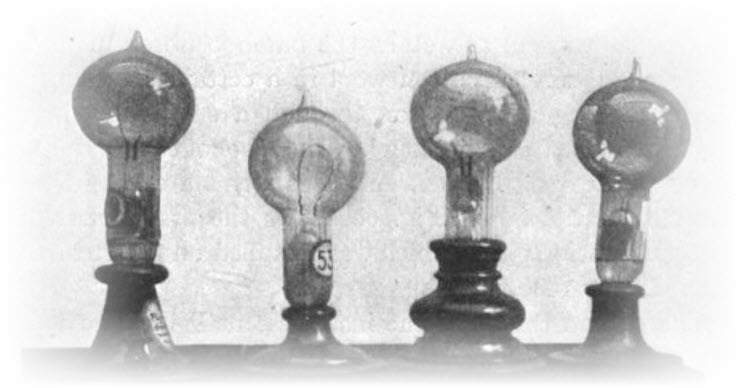
I only included a few of Edison’s inventions in my little encyclopedia of weird inventions of yesteryear. It’s called Real Steampunkery Tech: True Contraptions of the Steam and Diesel Eras, and it mainly focused on stranger things than Edison typically created.
Let’s begin with phonograph cylinders, also called Edison cylinders, or wax phonograph cylinders. The earliest commercial medium for recording and reproducing sound, and were for use on a on a mechanical cylinder phonograph. In their heyday (c. 1896–1916) they were known as “records” — a name which has been passed on to the disc-shaped successor.
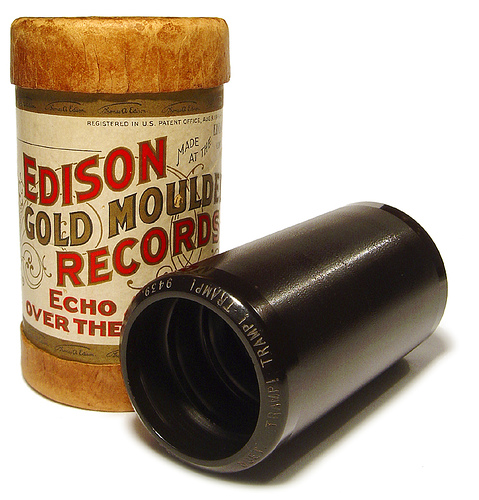
They were hollow cylindrical objects with audio recording engraved on the outside surface, which can be reproduced when they are played. The first cylinders were wrapped with tin foil, but the improved version made of wax was created a decade later. They remained the dominant commercial audio medium until the 1910s.
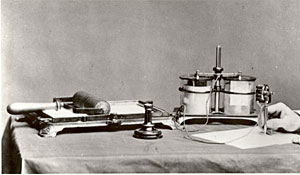
The electric pen. Patented in 1876, Edison’s electric pen was the first, and arguably one of the most successful, early commercial electric appliances, paving the way for mimeographs and tattoo machines. It operated as an early copying machine, allowing users to create stencils to produce up to 5,000 copies of documents. How did it work? A small electric motor at the top of the pen powered a needle that moved up and down at high speed, creating a series of small holes in paper as the user wrote. The device was powered by two wet-cell batteries connected by wires.
Wax paper. In 1872, Edison came up with paraffin paper, or the idea of coating paper in wax to keep it from getting wet, to use in the telegraph. This is a commonly used household object today, and its origins began with wrapping candy. Paraffin paper was also used to help Edison invent his favorite device, the phonograph.
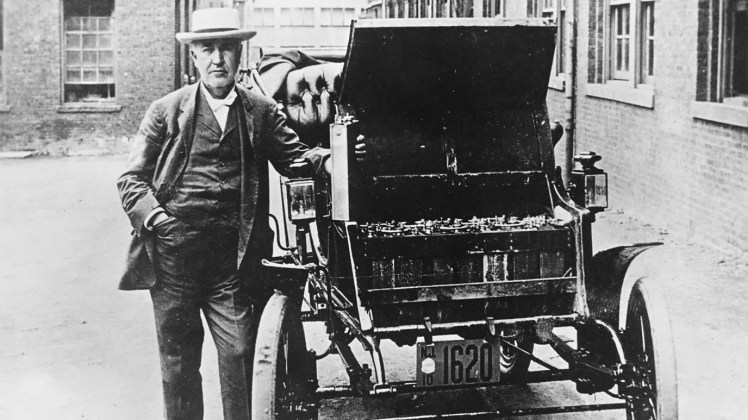
Hmmm… he doesn’t look like such a cranky tool in the photo above. You can’t believe everything you read. But then again, in that picture he’s also a guy with his new car…
The alkaline storage battery. Patented in 1901 and 1906, Edison invented a rechargeable Nickel-Iron battery. It was designed to be a durable, lightweight, and long-lasting alternative to lead-acid batteries. Using a potassium hydroxide electrolyte, it aimed to power electric vehicles, though it eventually found success in industrial uses like mining lamps and train signaling.
Those are just a few of the inventions of Thomas Edison that still have an influence on our everyday lives. If you want to know what his spirit telephone was, or his contribution to how to answer the telephone, you can find those in Real Steampunkery Tech. Thanks for visiting. Friendly comments are welcome. Hugs.
♠ ♦ ♣ ♥
Here’s the obligatory shameless self-promotion.
Real Steampunkery Tech: True Contraptions of the Steam and Diesel Eras

E-book: relinks.me/B0DHC6JFVT
Paperback: relinks.me/B0DHD9BSJB
♠ ♦ ♣ ♥
This post is all-human written. Furthermore, the author expressly prohibits any entity from using this publication for purposes of training AI technologies to generate text. This is a work of fiction. Characters, names, places, and incidents are either the product of the author’s imagination or are used fictitiously, and any resemblance to actual persons, living or dead, business establishments, locales, or events is entirely coincidental.
Copyright © 2026 by Teagan Ríordáin Geneviene
All rights reserved.
No part of this work may be reproduced, scanned, or distributed in any printed or electronic form without permission. Please do not participate in or encourage piracy of copyrighted materials in violation of the author’s rights.
All images are either the property of the author or provided by free sources, unless stated otherwise.


This is a fascinating post, Teagan.
Edison was, and is still impactful in our daily lives.
The pic by his car… he doesn’t look cranky to me, but he looks hiding cranky. LOL!
Big hugs for you and the Scoobies!
LikeLiked by 1 person
Thanks for commenting, Resa. I thought that was a great and happy looking photo when I first saw it. Then as I learned more about him personally, his expression started looking really smug to me. It’s still a fun pic. Hugs back to you and Norm — and Misha!
LikeLike
It’s a very cool pic. And anyway, Edison wasn’t about being Mr. Personality. He was Mr. inventor! Hugs!
LikeLiked by 1 person
I loved this, Teagan! Thank you for adding to Dan’s tools. It’s the phonograph cylinder that I find must interesting.
LikeLiked by 1 person
Those cylinders amaze me, Jennie. So do any of the old music boxes with cylinders. Thanks for spending part of your day here. Hugs.
LikeLiked by 1 person
I feel the same way. Always a pleasure to be here, Teagan. Really.
LikeLiked by 1 person
Excellent post, Teagan. Edison’s inventions and contributions were tremendous. His comments about women and the historical context is interesting. My personal opinion is that many men have been intimidated by women throughout history, dismissing their opinions on important matters. This continues today when you see men forcefully attacking women in the media and other public settings.
A small comment made by John Adams in response to Abigail’s insistence on women’s rights, saying that men were already “limited” in their power, made me think that many men have a very narrow view of their purpose in life, whereas women see themselves as capable of engaging in every aspect of life.
LikeLiked by 1 person
Thanks for commenting, Edward. I enjoyed your post about Abigail Adams. I know that my opinion in work settings has been repeatedly dismissed. I realize that this does not happen to all women. Once I spoke in admiration to a woman at USPTO in a presidentially appointed position. I mentioned what she must have had to overcome (of that nature), and she drew back in astonishment, saying she never experienced anything of the sort. (Although her father was extremely well connected and so was her husband… maybe nobody dared.) I on the other hand, repeatedly had to “fight” my way out of corners.
You’re probably right about the feeling threatened part. Once a male coworker (different department, same field) ranted at me that I was taking jobs away from men. A different coworker (different job) laughed out loud at the discrepancy in my salary (which he learned about without me stating it). Those and other “personality differences” were constant throughout my career. Married women face a lot of the same, I’m sure. Although, from everything I saw in the past 40 years, unmarried women get it full blast. It seems to take on an entire other aspect. Anyhow, enough of my “ponderating” on that. Wishing you a splendid weekend. Hugs.
LikeLiked by 1 person
You’re welcome, Teagan. That USPTO woman was definitely being political. At the senior level, people are extremely careful about what they say. Thank you, my friend.
LikeLiked by 1 person
Edison — Yuck! Sara and I are Team Tesla all the way! lol It tickles me that just about once every season, The Murdock Mysteries had Edison as the suspect of a murder investigation. 😀
LikeLiked by 1 person
Really? I missed that. Too funny. I haven’t gotten Murdock in years, but I liked it. Tesla and his phobias, and the pigeon — how could I not love him? Hugs.
LikeLike
Hi Teagan, of course I know if Edison and his marvelous inventions. I didn’t know he was an unpleasant person. Mind you, that is a bit of a common thread with obsessive people.
LikeLiked by 1 person
I think you’re right about that tendency, Robbie. I hope it’s been a thriving Thursday for you. Hugs.
LikeLike
🤗💖
LikeLiked by 1 person
When my husband and I lived in Florida, we visited the Thomas Edison and Henry Ford Winter Estates in Fort Myers. Fascinating place! I seem to recall there was a friendly rivalry between the two?
LikeLiked by 1 person
Liz that’s an interesting tidbit that I had not picked up on before. How unexpected. Here’s a little article about it: Thomas Edison and Henry Ford Were Both Iconic Inventors and Best Friends | Discovery
I went through Ft Meyers a number of times, but my family never stopped there. Thanks for reading and commenting. Hugs.
LikeLiked by 1 person
You’re welcome. The museum is well worth a visit.
LikeLiked by 1 person
Wax paper is in constant use in my art creation. It has many many uses.
He does not sound like a great human being, but Edison definitely left his mark on the world. (K)
LikeLiked by 1 person
Hi, Kerfe. That’s cool about the wax paper. Suddenly I have a shadowy vague memory of an art project when I was a child that involved ironing wax paper. But that’s all I remember of it.
Perhaps Edison’s negative qualities were glossed over and forgotten because so many of his contemporaries shared his attitudes. In other words it was too ordinary to mention. (Shakes head and sighs.) Many thanks for visiting. Hugs.
LikeLiked by 1 person
I think you are right. And unfortunately trending in that direction again…
LikeLiked by 1 person
True. There was a huge up-tick in those attitudes at my workplace in the last few years before basically everything became too much for me and I left. Just couldn’t do it anymore. Anyhow, wishing you a lovely rest of the week.
LikeLiked by 1 person
Thanks Reagan, you too.
LikeLiked by 1 person
I’m glad for his inventions and also glad I never net him, Teagan 😉 I will check this book out! Xo
LikeLiked by 1 person
By checking out I mean read! Xo
LikeLiked by 1 person
I know what you mean, Denise. Actually, I think I met more than enough like him, although not inventors. Heartfelt thanks about the book. Big hugs.
LikeLiked by 1 person
Edison was a genius and way ahead of his time. It would be interesting to have a conversation with him. 🙂
LikeLike
He’s quoted as saying “Direct thought is not an attribute of femininity. In this, women are now centuries behind man.” So he might have a light chatty conversation with you, after he patted you on the head. I’m sure it would be interesting. 😀
LikeLiked by 1 person
I enjoyed your discussion of Edison. He was a genius for sure. I wonder what today would look like had he not been so prolific in his inventions. Happy Wednesday and Hugs.
LikeLike
Hi, John. Yes, he had a mind boggling number of inventions that amazingly ranged from everyday-useful (like hearing apparatus or lightbulbs) to strangely absurd (like the spirit telephone). I was commenting to Dan about it making for an alternate history story. Happy March — and hugs.
LikeLiked by 1 person
😁
LikeLiked by 1 person
Edison was quite the inventor, and you gave us some information that I never knew! The images are great – I love the one of the old phonograph! I had to laugh because when I was in high school back in the dark ages, we used to call someone who behaved stupidly a tool.
LikeLiked by 1 person
Hi, Noelle. Haha, “tool” as slang (with a few different negative but similar meanings) has been around since the 16th century. I always thought it started in the 80s, but slang rises and falls in popularity sometimes. Thanks for visiting. Hugs.
LikeLike
Well, I just learned something else new! I haven’t heard that word used derogatorily in years but it’s a good one. Ear scritches to the Scoobies.
LikeLike
A great post, as always, Teagan, and very informative. I knew about some of his inventions, but, as you say, there were so many it’s difficult to keep track. I love the images and I recommend your book Real Steampunkery Tech. It is fantastic! Take care, big hugs, and love to the Scoobies!
LikeLiked by 1 person
Heartfelt thanks for the recommendation, Olga — You did such a wonderful review post on the book. Hugs winging back to you from the Scoobies and me. Happy March. ❤
LikeLike
Thanks for joining us at CFFC, Teagan and thanks for featuring the successful, albeit sometimes questionable inventor of the wonderful world of invention era. The amazing part is how many of his inventions remain with us (in some form) today.
If anyone reading this comment is wondering about Real Steampunkery Tech: True Contraptions of the Steam and Diesel Eras, stop wondering and buy the book. You won’t regret it.
LikeLiked by 1 person
Those ponderings have the makings of an alternate history story, Dan. Imagine if Edison’s battery powered electric car had taken hold and gained acceptance rather than Ford’s — and what other differences might have cascaded from that. Thanks for reading and commenting. And for your endorsement of the book. 😀 Big hugs.
LikeLiked by 1 person
The acceptance of an electric vehicle at that time would have had significant impact on a lot of things, Teagan. Maybe in an alternate universe…
LikeLike
Fabulous Teagan. So many wonderful inventions. Well researched and written
LikeLiked by 1 person
It’s good to see you, Brian. Many thanks. Happy March. Hugs.
LikeLiked by 1 person
Such a great book Teagan! So fascinating. Edison was remarkable. Love the cover you’ve chosen. 🤗
LikeLiked by 2 people
Thanks so much, Holly. I put a lot of thought into the various pieces of the composite image I made for the cover. It went through a lot of drafts. 😏. I appreciate you visiting. Wishing you an easy coast down this midweek hump. Hugs.
LikeLiked by 1 person
You did a great job! Have a wonderful week yourself. Hugs back
LikeLiked by 1 person